Muskoka Lakes Boathouse Permit Rules: What to Check Before Closing
September 24, 2026
September 24, 2026
The question usually comes up during the second week of a deal, after the excitement of an accepted offer has worn off and a lawyer starts reading the file line by line. It sounds simple enough: has this boathouse ever had a building permit? On a lake where boathouses are half the reason people buy, that one question can hold up a closing for weeks, and on Lake Joseph, Lake Rosseau and Lake Muskoka, it comes up more often than most buyers expect.
The reason is not that Muskoka Lakes cottagers built carelessly. It is that the rules changed under their feet, slowly, over decades. That shift has quietly turned an old, permitted, two-storey boathouse into one of the scarcer assets on these lakes, and it is worth understanding why before you sign anything.
The Township of Muskoka Lakes regulates shoreline structures as a share of your property's water frontage, not as a flat square footage. The Zoning By-law's Waterfront Zones section splits the calculation by storey, capping a lower level at 16 percent of frontage and an upper level at 13 percent, with the exact figure in the by-law's tables keyed to your lake's classification and your specific frontage bracket. For a Category 1 lake, the designation that covers Joseph, Rosseau and Muskoka, planning staff have applied a tighter 10 percent ceiling on cumulative boathouse width in at least one recent file, according to a Township planning report.
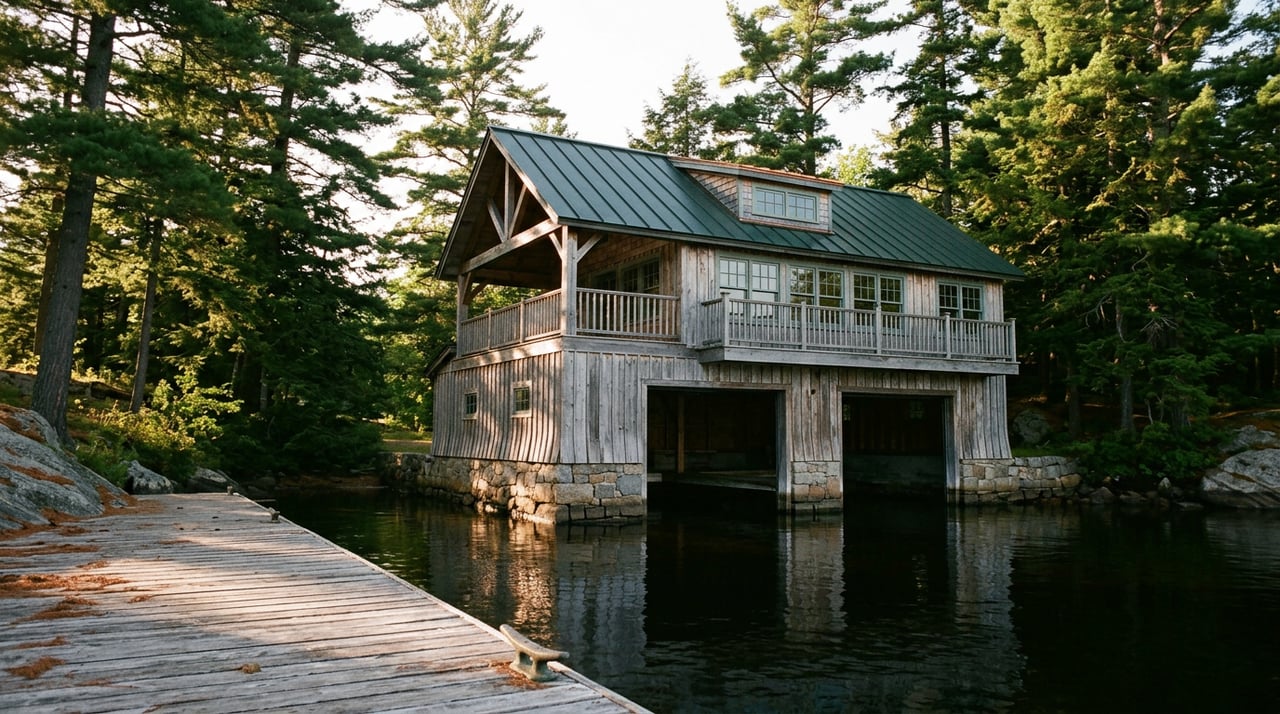
The math sounds dry until you apply it to an actual shoreline. A modest 100-foot lot gives you roughly 10 feet of allowable boathouse width under a 10 percent cap. Anyone who has stood on a Lake Joseph dock and looked at a two-slip boathouse with a wraparound deck above it knows that structure did not fit inside 10 feet. Most of the grandfathered boathouses on these lakes were built before today's percentages existed.
You do not have to take that as an abstract claim. A December 15, 2025 planning report on a Highway 169 property on Lake Joseph laid the numbers out in black and white. The file involved a shoreline consolidation across four units, two boathouses and a dock, and it found the existing cumulative shoreline width worked out to 31.1 percent by actual measurement, or 42.71 percent under the by-law's calculation method, against a 10 percent maximum for a Category 1 lake.
Staff recommended approval anyway, reasoning that the structures had existed for years, no new construction was proposed, and the functional and visual character of the shoreline would not change. But approval still required a formal zoning by-law amendment tied to a lot line reconfiguration, not a rubber stamp. That is the part worth sitting with. Even a boathouse that has quietly stood on a shoreline for decades can require a documented planning file to regularize, and staff discretion is not the same thing as a permit already in hand.
This is where the math turns from a zoning curiosity into a pricing signal. When a bylaw makes it functionally impossible to build a large or two-storey boathouse on an already-developed lot, an existing one stops being a simple amenity and starts behaving like a scarce asset. A buyer is not just purchasing a place to store a boat. They are purchasing frontage rights that current zoning would not grant to anyone building fresh today.
You can see that logic play out at the top of the market. This past August, a roughly $25.9 million Lake Joseph estate spanning 346 feet of shoreline came to market through Chestnut Park with a two-storey, three-slip boathouse as one of its headline features, alongside a Muskoka Room built for entertaining. A property with that much frontage has more room to work with than most, but the listing still treated the boathouse as a defining asset rather than a footnote, which tells you how the market itself is pricing this kind of structure.
The flip side matters just as much for a typical resale. An unpermitted or undocumented boathouse does not just fail to add value. It can actively subtract it, because a buyer's lender, insurer and lawyer will all want to see proof it was ever legal, and retroactive approval is neither guaranteed nor cheap.
None of this is frozen in place. The Township is partway through a rewrite of its Comprehensive Zoning By-law to bring it into conformity with the 2023 Official Plan, a process the Planning Act requires within three years of an updated Official Plan taking effect. As of the Planning Committee's May 14, 2026 meeting, that work was paused until after the municipal election, with staff directed to fold the recommended amendments into a first draft once the project resumes.
That pause matters for anyone buying or selling now. It means the specific percentages and frontage thresholds in play today are not guaranteed to be the ones in force a year from now, and it is worth confirming current numbers with the Township's planning department rather than relying on a bylaw summary written before the rewrite lands. You can follow the project directly through the Township's own Comprehensive Zoning By-law Update page.
If you are on either side of a Muskoka Lakes waterfront deal with a boathouse involved, a few questions are worth asking before any condition gets waived.
None of these questions are about whether the boathouse is beautiful. They are about whether it is documented, and documentation is what a lender, an insurer and the next buyer's lawyer will all ask for eventually.
If my boathouse is legal non-conforming, can I ever add to it? Generally, no, not in terms of footprint. The by-law allows interior alterations to make an existing non-conforming structure more functional, and it allows a height increase in some cases, but only if there is no increase in floor area. The structure you have is largely the structure you keep.
Does a bigger boathouse automatically mean a bigger sale price? Not on its own. Size only adds value when it is backed by a clean permit history. An oversized, undocumented structure can cost more to regularize, insure or remove than a smaller compliant one is worth, which is exactly the kind of detail a buyer's lawyer is trained to find.
What happens if I want to finish the upper level of my boathouse as a bunkie? Enclosing that space for living use brings higher construction costs and a supplemental tax bill once the new assessment catches up. It is worth pricing that shift in before you commit to the renovation, not after.
Boathouse permits are not the most glamorous part of buying or selling on these lakes, but they are often the part that decides how smoothly the deal actually closes. If you are weighing a purchase or preparing to list a property with a boathouse anywhere on Lake Joseph, Lake Rosseau or Lake Muskoka, Marilyn Mannion has spent decades walking these shorelines and knows which questions to ask before conditions come off. Let's Connect.
This article is general information, not legal, tax or financial advice. Consult a qualified professional about your situation.
Stay up to date on the latest real estate trends.

Let me help you with your Muskoka real estate needs.